The Great Relearning
The Story of How We Lost Education and Why We’re Taking It Back

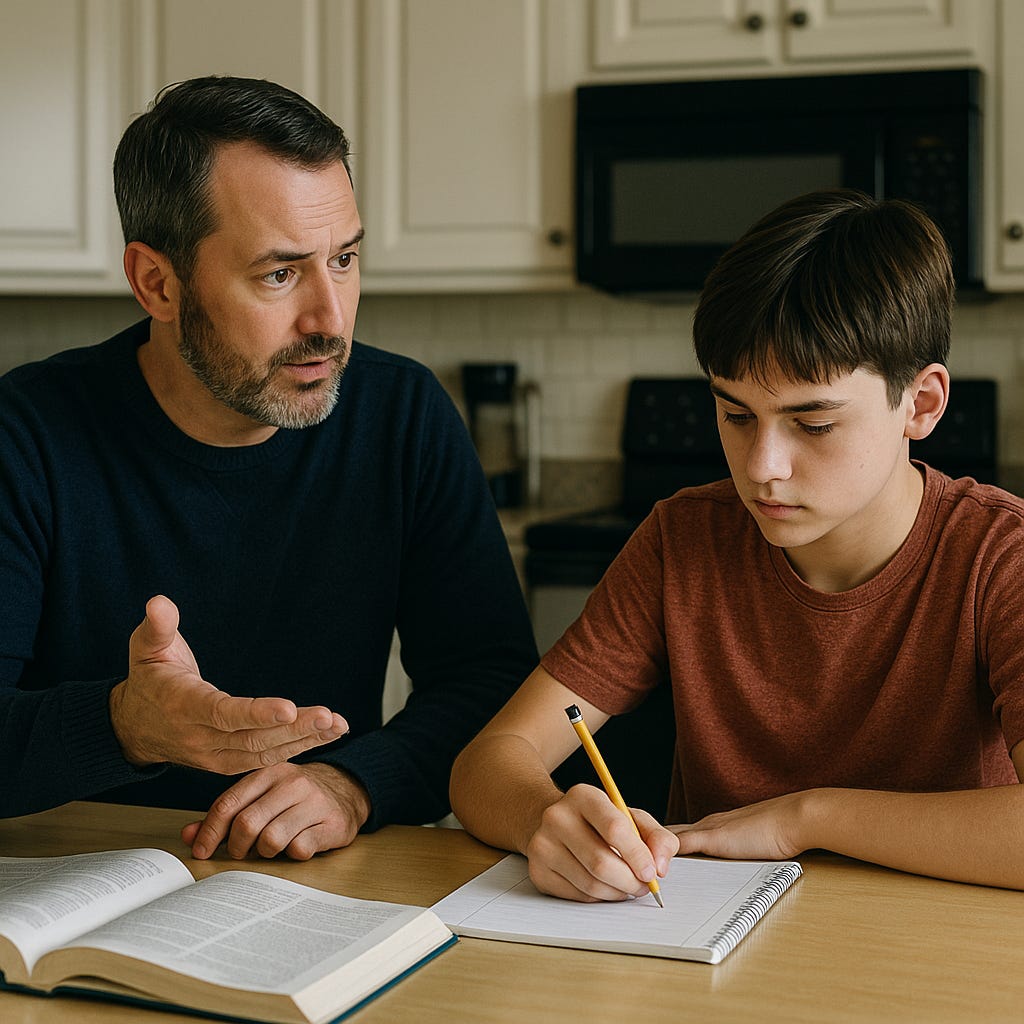
The moment I knew something was wrong with our education system didn’t happen in a classroom. It happened at my kitchen table. My son had started getting failing marks on his homework. At first, I thought he was distracted or rushing through it. Then I looked closer. His test scores were perfect, straight As every time.
I asked him, “Why aren’t you finishing your homework?”
He didn’t even look up. “Because after the first three questions,” he said, “the rest are the same questions.”
That stopped me. Here was a kid who understood the material so well he could ace every test, yet the system was punishing him because he refused to repeat busywork. He wasn’t being rewarded for mastery; he was being trained for compliance.
That moment stayed with me. It made me realize that the problem with education isn’t just what we’re teaching. It’s why we’re teaching it, and what we’re teaching kids to believe about themselves. We tell them to follow the rules, do the worksheets, and stay inside the lines, even after they already understand the lesson. We confuse repetition with rigor and conformity with intelligence. We reward obedience over insight. And in doing so, we extinguish the very spark that education is supposed to ignite.
Over time, I began to see that what happened at that kitchen table wasn’t unique. It was a small window into a much larger truth: we didn’t lose education overnight. It slipped away slowly, buried under good intentions and bad incentives. For decades, we poured more money, more bureaucracy, and more theory into a system that measured everything except meaning. What began as an effort to expand opportunity turned into an industry of dependency. Students became debtors. Teachers became employees of policy rather than mentors of curiosity. Parents became spectators. Somewhere along the way, we stopped asking what education was for and started assuming it was someone else’s job to provide it.
The result is what we have today—a system that spends more than ever and achieves less than ever. Reading scores are collapsing. Attention spans are shrinking. Confidence and purpose are evaporating. We’ve built an empire of credentials that no longer guarantee competence. You can hold a diploma and still not know how to think critically, build something, or navigate the real world. We’ve mistaken certification for skill, permission for purpose, and process for progress.
A few years ago, I met a young developer in Russia who changed how I see everything. He had built an app that rivaled what Silicon Valley was producing, with clean design, powerful code, and thousands of active users. He had no degree, no investors, and no official credentials—just determination, curiosity, and an internet connection. When I asked where he studied, he smiled and said, “The internet.” That moment hit me hard. While our institutions were debating policy reforms and tuition increases, the world had already moved on. The future was being built by self-taught learners who refused to wait for permission. They didn’t need validation from a system that had stopped validating itself.
That realization became the seed of what I call The Great Relearning. It isn’t a reform. It’s a rebuild. It’s the recognition that education is not something we fix from the top down, but something we restore from the inside out. It’s about returning to a simple truth: knowledge belongs to everyone, and freedom is the ultimate classroom.
I began to see it happening everywhere. Mothers in Texas building their own home academies. Professors leaving universities to teach directly to global audiences. Teenagers in Indonesia teaching math and design online, earning real income before they could even graduate. Everywhere, people were quietly stepping outside the old structure and discovering that learning doesn’t need permission—it only needs purpose. The Great Relearning is the story of human capability breaking through institutional decay.
What makes this movement powerful isn’t technology itself—it’s ownership. Teachers are becoming entrepreneurs again. They’re setting their own prices, owning their work, and building direct relationships with learners who value them. Students are learning what they love and proving it through results. Families are reclaiming their place as the first and most important teachers. Education is finally becoming what it was always meant to be: a shared act of creation, not a managed process of compliance.
Technology simply scales what freedom makes possible. Artificial intelligence, blockchain, and open platforms give teachers the reach and learners the proof. They remove the gatekeepers and make trust measurable. For the first time, learning can be verified without an institution’s permission. The classroom has become the cloud, and the diploma has become the portfolio. The question isn’t where you studied; it’s what you can do and how well you can prove it.
At the center of this transformation is something moral, not mechanical. Education is not a service delivered by the state—it is a birthright exercised by the individual. Faith gives it purpose. Family gives it context. Freedom gives it power. Without those three, education becomes data without direction, progress without principle. The Great Relearning isn’t anti-school; it’s pro-human. It’s the recovery of what education was always meant to cultivate: curiosity, courage, and capability.
Everywhere I look, I see proof that the shift is already underway. A single mother turning her expertise into a thriving online course. A retired engineer mentoring young creators on how to build real businesses. Companies hiring based on skill, not degrees. None of them are waiting for permission. They’re simply creating, teaching, and proving what they can do. They are not exceptions. They are the future.
The next decade will belong to those who can demonstrate what they know and share what they’ve learned. Bureaucracies won’t keep up. Institutions will try to regulate it, brand it, or slow it down—but they can’t stop it. The Great Relearning isn’t an initiative or a campaign. It’s a rebirth of capability, a quiet revolution of people deciding to take back ownership of their own minds.
That is the world we’re building with ArkHub
: a marketplace where teachers, learners, and employers connect directly, exchanging value in real time, verified by technology but grounded in trust. It isn’t about disruption for its own sake. It’s about rebuilding education around the people it was always meant to serve. No middlemen. No gatekeepers. Just a transparent, living system of human potential.
I believe the next Renaissance will not come from universities or ministries. It will come from ordinary people rediscovering their own capacity to learn, teach, and create. It will come from those who remember that education was never supposed to be a hierarchy—it was meant to be a highway. The Great Relearning is that highway. It’s open to anyone with curiosity, courage, and conviction.
The future doesn’t belong to the credentialed. It belongs to the capable.
Richard Maaghul
Founder, ArkHub.com, building the new economy of learning, commerce, and creation
Author’s Note
I wrote this after realizing how many bright kids like my son are punished for thinking differently. The Great Relearning is for them, and for every teacher and parent brave enough to rebuild something better.